
Ruby Ridge
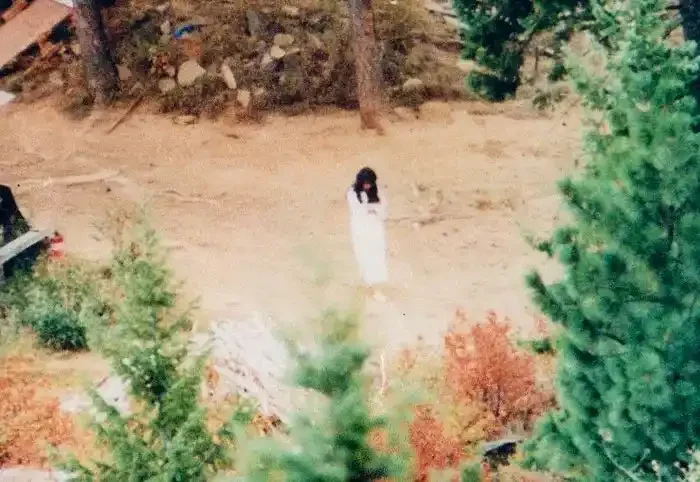
Randy Weaver was discharged from the US Army on October 8th, 1971. After leaving the Army, Weaver married Vicki Jordison. The two moved back to Iowa where from 1976-1982 they had three children. While living in Iowa, the Weaver family began adhering to Christian fundamentalist ideologies and sought a simpler, uncomplicated, off-grid life away from government overreach. So, in 1983, the couple bought a 20 acre parcel of land near Boundary County, Idaho. There, they built a modest cabin, grew their own food, hunted their property, and practiced their faith.
In 1987, Randy Weaver met Gus Magisano at the Aryan Nation World Aryan Congress. The two would meet again in 1989 at an Aryan Nations meeting hall. Weaver is known to have stated that rather than being a “white supremacist” he identified more as a “white separatist.” Regardless of his self identification, Weaver knowingly frequented the meeting hall seeking camaraderie and like-minded individuals.
After meeting for the second time, Magisano and Weaver hit it off, ultimately coming to an under-the-table business deal. Despite being notoriously defensive and skeptical in nature, Weaver agreed to provide Magisano with two sawed-off shotguns. The deal progressed to the point where Weaver agreed to provide Magisano four to five illegal weapons per week.
Unbeknownst to Weaver, Magisano’s real name was Kenneth Fadeley. Fadeley was an undercover ATF agent sent to investigate the Aryan Nations complex. In December of the following year, Randy Weaver was indicted on felony weapons charges. By the time of the indictment, the Weavers had already moved to a cabin in Ruby Ridge, near the Selkirk mountains of Idaho.
On January 18th, 1991, US Marshals posed as broken-down motorists to lure Randy Weaver to his arrest. Weaver was arraigned on federal weapons charges and notified that he was to appear in court on February 19th. A week after his arraignment, the court clerk informed the Weavers that the trial date was moved to February 20th. However, US Probation Officer Karl Richins mistakenly told the Weavers that the trial date had been rescheduled for March 20th.
Naturally, Randy Weaver did not appear in court in February.
A six-month period of negotiations ensued between US Marshals and Randy Weaver, with Marshals negotiating for a peaceful surrender and Weaver refusing, as he vehemently believed the federal government was conspiring against him.
Between October 1991 and August 1992, negotiations and dialogue between US Marshals and Weaver ceased. During this time, the Marshals were conducting extensive surveillance of the Weaver property, considering numerous courses of action to arrest him. Marshals assessed that given Randy Weavers background, the Weaver family ideology, and the circumstances of his arraignment, that any escalation of the situation would result in violence.
On August 21st, 1992, a six-man reconnaissance and surveillance (R&S) team approached the Weaver household, splitting into two teams: a three-man observation and overwatch team and a three-man surveillance and intelligence team. The intention behind the covert approach was to serve Weaver under a bench warrant for his arrest for his failure to appear in court. Around 9am that morning, the reconnaissance team cautiously approached the cabin. The team identified the family dog Striker outside the cabin. US Marshal Art Roderick decided to toss a small stone in the direction of Striker to provoke the dog and determine if anyone else was outside at the time. The dog quickly reacted, posturing aggressively and pursuing the origin of the disturbance. The dogs aggressive reaction alerted 14-year-old Sammy Weaver, the only son of Randy and Vicki, along with family friend 24-year-old Kevin Harris. As Striker caught the scent trail of the Marshals, he began to approach them, prompting Roderick to discharge his weapon and killing the dog instantly. Naturally, Sammy and Kevin both drew their weapons and a very brief firefight erupted. Harris, armed with a .30-06, fired at the reconnaissance team killing Deputy US Marshal William Francis Degan. It is undetermined if the US Marhals formally declared their presence at any point before, during, or after the firefight. Sammy, armed with a 9-millimeter pistol, fired towards the reconnaissance team but did not make contact. At this time, Sammy and Kevin began retrograding back to the cabin. While running with their backs turned Deputy Marshal Larry Cooper fired at Sammy Weaver, striking him in the back and killing him almost instantly.
After the initial firefight on August 21st, the situation rapidly shifted from a covert surveillance operation into a federal crisis response. The six-man R&S team withdrew from the mountain as the threat level had drastically increased. Upon reporting that Deputy US Marshal Degan had been killed, a mandatory federal escalation protocol was triggered and the FBI’s Hostage Rescue Team (HRT) was called in.
The scene was now set for a contingency no US federal entity had seen before against a family that had been preparing for years.
Multiple agencies began coordinated planning, with the USMS maintaining operational control. Once the FBI was notified, they began preparing to take over the situation if needed. Due to the extremely restricted terrain surrounding the Weaver property, a strategy of containment, rather than direct action, was put into motion. By the end of the first day, less than 24 hours after Sammy Weaver was killed, the property was surrounded and monitored continuously as a siege posture was established. On the morning of August 22nd, the FBI formally took over the role of overseer of the operation. The FBI issued rules of engagement allowing agents to proactively engage any and all armed adult males seen outside the cabin.
In the afternoon of August 22nd, these controversial rules of engagement came to fruition. Kevin Harris and Vicki Weaver were observed near the cabin when FBI sniper Lon Horiuchi fired at Harris striking him near the shoulder. Almost immediately, Horiuchi cycled the action on his Remington Model 700, seated another round, and fired at an unarmed Vicki Weaver as she stood in the doorway holding her 10 month old baby. The well aimed shot struck Vicki centermass, doubling her over and killing her within minutes. With only two rounds fired from one Marshal, the situation exponentially escalated yet again.
From August 23rd to the 25th, no progress was made from either side, nor were any legitimate negotiation attempts made.
On August 26th, the FBI formally emphasized that they were only to attempt peaceful negotiations over direct action as there was immediate public backlash from the initial shooting just five days earlier.
The use of loudspeakers and intermediaries were implemented to pass messages to Randy and his family, though his distrust of the federal agents remained.
After nine days of escalation, firefights, and stalemate, former Green Beret Bo Gritz was pivotal in the progression of the siege. Gritz walked up to the Weaver family cabin in the midst of an armed siege to act as the intermediary on behalf of both parties. Due to Bo Gritz’s efforts, on August 31st, 1992, after an 11-day armed standoff, the siege finally ended.
The incident that took place over the course of those three years culminated to quite possibly the worst outcome any participant could have imagined. Randy Weaver lost his wife, his only son, his family dog, and his close friend was merely inches from death as well. The US Marshals lost Deputy Marshal Degan along with the trust of nearly the entirety of the nation they swore to defend.
The events that ushered in the 1990s were to be retoroactively recognized as a catalyst for numerous examples of government overreach against the US people that were soon to follow.
In just a matter of 24 hours, small interactions on a mountain top in Idaho rapidly matriculated out of its infancy, formally maturing to what is now widely known as the Siege of Ruby Ridge.