
Rooftop Koreans
On March 3rd, 1991, California native Rodney King was caught speeding on the Foothill Freeway of the San Fernando Valley of Los Angeles. Consequently, LAPD officers attempted to pull him over as he was also visibly heavily intoxicated. King had other ideas, as he led the police on an 8-mile, high-speed chase, reaching speeds of up to 115 mph before being cornered and pulled from his 1988 Hyundai Excel. He likely attempted to evade law enforcement because he was currently on probation for a robbery conviction. When King resisted, the four white police officers on the scene tased him twice, and when he attempted to stand up, he was beaten with batons.
Unbeknownst to the officers, an uninvolved bystander recorded the assault and subsequently sold the 89-second clip to a local television station, ultimately making national news seemingly overnight.
Over a year after the initial incident, at 3:15pm on April 29th, 1992, the four LAPD officers involved were acquitted of all charges. The stage was set for the Los Angeles Riots of 1992.
Within the hour, small groups of dissatisfied citizens began massing at the intersection of Florence and Normandie, the location in which King was assaulted just a year prior. The mobs continued to rapidly grow in size, reaching an estimated size of 200-400 people. At 5:40pm, the horde had reached its breaking point. Culminating in the first documented attack when 33-year-old Reginald Oliver Denny, a construction truck driver on shift, was in his red dump truck hauling a load of sand to a nearby plant in Inglewood.
Denny was violently pulled from the cab of his truck and viciously beaten to the point of near death by four black assailants. His skull was fractured after one of his attackers dropped a cinderblock on his defenseless body.
The unrest continued to escalate as the disgruntled community began widespread looting across Los Angeles County. Fires were started, innocent bystanders attacked, and infrastructure and buildings damaged.
Tensions between the Korean and black community had been intensifying, coelescing on April 30th, 1992. Rioters set their sights on Los Angeles’ Koreatown, a 2.7 square-mile neighborhood west of MacArthur Park. This was not coincidental as on March 16th, 1991, less than two weeks after Rodney Kings televised assault, a Korean store owner named Soon Ja Du shot and killed a 15-year-old black girl named Latasha Harlins after Harlins placed a small container of orange juice in her backpack. Du declared she confronted Harlins, the altercation got physical, and then Du shot Harlins one time in the back of the head, killing her instantly.
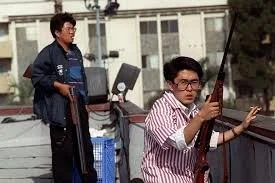
The lack of armed presence coupled with mounting racial and socioeconomic tensions offered disgruntled citizens unhindered access to Koreatown. In response, the Korean storefront owners and citizens living in the neighborhood were left to organize their own armed security teams. Many of these immigrants were veterans, having served in the Korean armed forces before emigrating to America. Their tactic was to stage on the roofs of their businesses and defend their livelihood from the importunate mass. Korean radio stations across Los Angeles began putting out radio calls for volunteers to help the business owners. Volunteers began showing up with anything from home-made defense weapons to modern assault rifles.
From April 29th to May 4th, the Korean business owners endured 5 days of looting, burning, and shooting, resulting in massive financial and personal losses. Pandemonium was sweeping through the streets of Los Angeles reminiscent of a third-world civil war.
The Koreans maintained that they did not initiate the violence, but infact were fired upon first which led to the prompt retreat from the limited police presence in the area.
Upon conclusion of the LA riots the death toll reached 63 with over 2,300 injured. An estimated 2,000 Korean business owners underwent near or total destruction of their livelihoods. In all, roughly $400 million of the total estimated $1 billion in damages occured in Koreatown. Two people were killed in Koreatown: Patrick Bettan, a white security guard defending the local businesses, and an 18 year old Korean man that was mistaken for a looter.
When discussion of unwavering loyalty and dedication enter dialogue, the support and cohesion of the Koreans always come to mind.
Though no single resident of Koreatown was exalted into infamy, the entirety of the Korean defenders quickly established that they are a formidable force, ultimately becoming known as the Rooftop Koreans.