
SS Edmund Fitzgerald
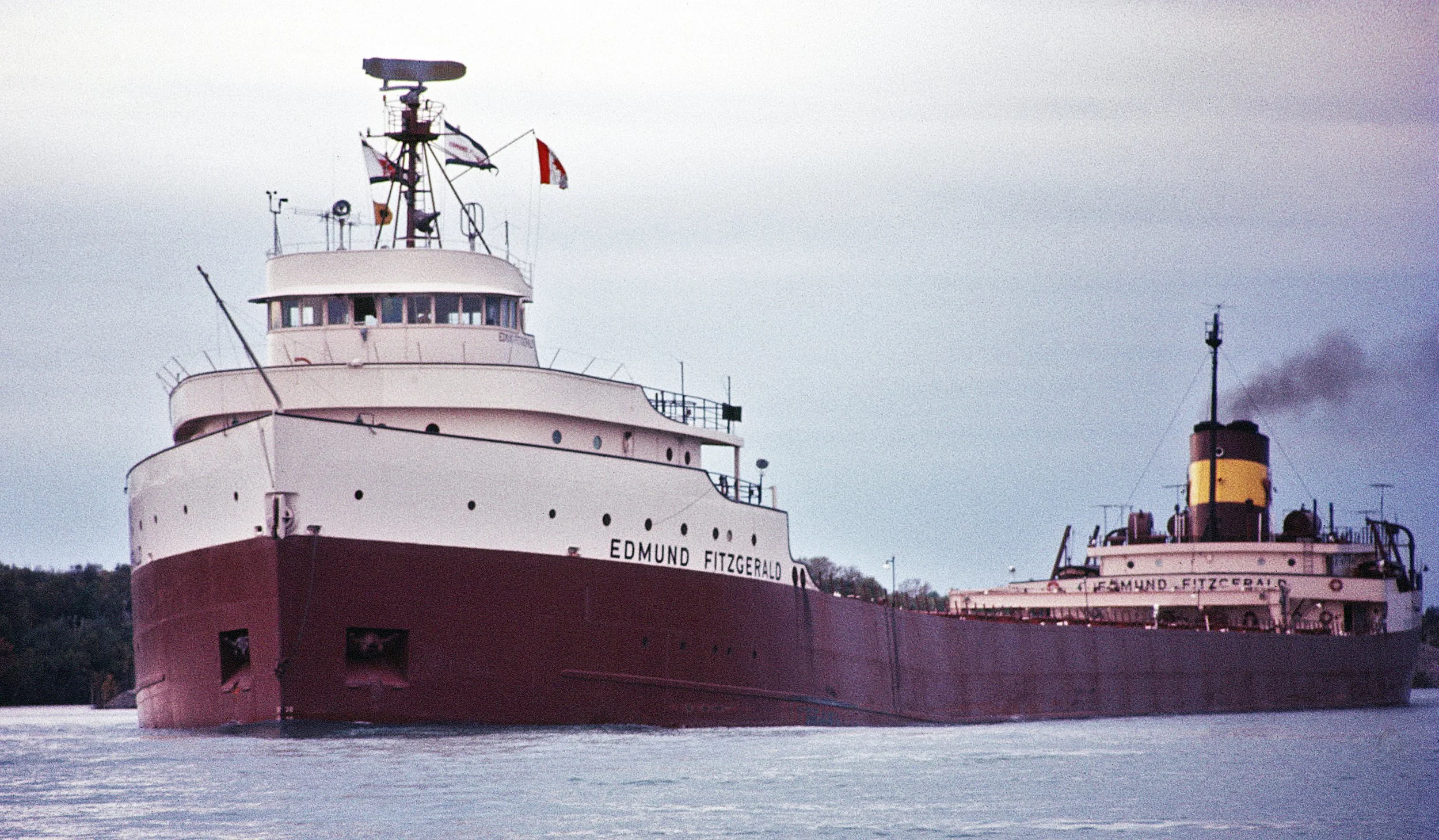
The SS Edmund Fitzgerald was a large freighter that operated solely in the American Great Lakes. At the time of her launch on June 7th, 1958, she was the largest ship to have ever sailed the Great Lakes. The massive vessel was 730 feet long, and capable of carrying upwards of 26,000 tons, near twice her empty weight. Over her 17 year tenure, the “Toledo Express” developed a cult-like following, taking on her own personality amongst the residents of the Great Lakes region. The regional following was not only due to the sheer size of the vessel, but the nature of the ship, as it readily personified the hardworking, head-down, mind-your-own-business mentality that embodies the Midwestern people.
Primarily facilitating the booming Midwestern steel industry, the “Big Fitz” predominately carried taconite iron ore pellets from Minnesota mines to steel mills in the Lower Great Lakes. In 1964, she became the first Great Lakes vessel to ever haul over one million tons in a season.
On November 9th, 1975, at around 2:15 PM, the Edmund Fitzgerald set off from Superior, Wisconsin, heading to Zug Island, a small island in the city of River Rouge, Michigan, at the southern city limits of Detroit. The crew consisted of 40+ year veteran Captain Ernest McSorley, along with 28 other highly experienced men, with 25 of the 29 crew members being Midwesterners. When the crew set sail, the weather was reportedly calm, with small waves and light winds. As the crew continued to settle in for their journey, a gale warning was issued by the National Weather Service at 2:39 PM, predicting winds of 39-54 mph. A low-pressure system that formed that morning over 700 miles away had rapidly made its way to the Great Lakes. At 1:00 AM on November 10th, 1975, the “Mighty Fitz” was reported to be 20 miles south of Isle Royale in Lake Superior. By this point the incoming storm was manifesting itself with 60 mph winds and 10 foot waves. After enduring the storm for six hours, Captain McSorley reported slowing wind speeds, but persistent 10 foot waves.
At 3:30 PM, the Fitzgerald radioed a nearby vessel, the SS Arthur M. Anderson commanded by Captain Jesse B. “Bernie” Cooper, reporting topside damage sustained that afternoon. The enraged storm pressed forward, consumed by acrimony, wielding 70 mph winds with up to 25 foot waves. Between 5:30 and 6:00 PM, the Fitzgerald made contact with the saltwater vessel Avafors, informing them that they were tilting, have lost both radars, and were taking heavy seas on the deck.
At 7:10 PM, Captain Cooper made contact with the Fitzgerald, asking how the ship and crew were doing. After valiantly battling the cyclone for nearly 24 hours, Captain McSorley radioed his last haunting transmission “we are holding our own.”
Captain Cooper never heard from the Fitzgerald again.
On November 10th, 1975, shortly after her last transmission, “The Pride of the American Side” broke into two pieces near Whitefish Point, Michigan. Sinking to the desolate floor of Lake Superior likely within minutes. Some 530 feet below the surface, she is still accompanied by all 29 crew members aboard.
Cementing herself in history and lore long before that fateful day in 1975, the Edmund Fitzgerald is now fondly remembered even more so throughout the Midwest as her 24 hour crusade is the embodiment of perseverance, bravery, and the Midwest archetype.